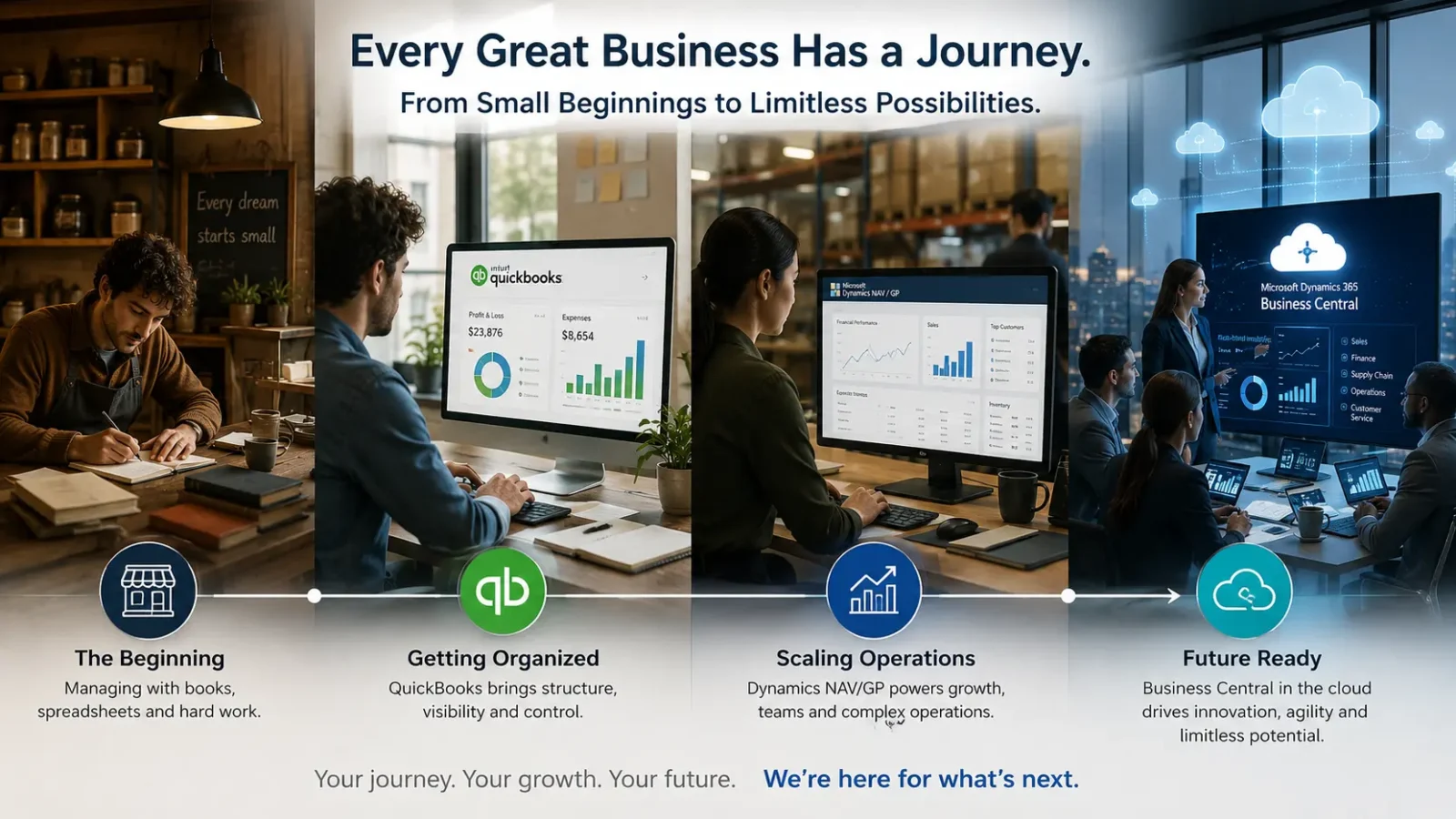
There was a time when QuickBooks was the perfect fit for your business. Then you grew. The same story may be unfolding again.
Every successful business reaches a point where the systems that once supported growth begin to limit it.
Years ago, many businesses relied on QuickBooks to manage their accounting. It was simple, affordable, and did exactly what it was designed to do. But as organizations expanded, so did their operational complexity. Multiple warehouses, larger inventories, manufacturing, field service, purchasing, and financial reporting demanded more than an accounting package could offer.
That was when thousands of businesses made the move to Microsoft Dynamics NAV and Microsoft Dynamics GP.
For decades, these ERP systems became the operational backbone of manufacturers, distributors, wholesalers, retailers, and professional service organizations around the world. They helped businesses streamline operations, improve financial visibility, and support years of sustainable growth.
Today, many of those same organizations are standing at another crossroads.
Not because Dynamics NAV or GP suddenly stopped working.
Not because they were bad investments.
But because business has changed.
Ten years ago, moving ERP to the cloud was a strategic discussion. Today, for most growing businesses, it’s becoming the default expectation. Employees expect to work from anywhere. Customers expect faster service. Decision-makers need real-time visibility. Artificial Intelligence is changing how businesses operate, and software is evolving faster than ever before.
The ERP that helped your business reach today’s success may not be the ERP that carries it through the next decade.
That’s exactly why organizations are increasingly evaluating Microsoft Dynamics 365 Business Central—Microsoft’s modern cloud ERP platform and the direct evolution of Dynamics NAV.
At Smetric, we’ve had this conversation with organizations across Los Angeles that aren’t looking to replace software simply because it’s old. They’re asking a much more important question:
“Has our business outgrown the ERP that got us here?”
If you’re asking the same question, these seven signs can help you find the answer.
💡 Smetric Insight #1
In reality, most organizations start exploring Business Central because their business has evolved. The software isn’t failing—the business has simply reached a point where modern capabilities create measurable value.
Smetric Insight
One of the biggest misconceptions we hear from businesses is that migrating to Business Central is driven by Microsoft’s product roadmap.
A Quick Look at the Microsoft ERP Journey
Understanding where Business Central fits starts with understanding Microsoft’s ERP evolution.
| Year | Milestone |
|---|---|
| 1980s | Navision is introduced in Europe. |
| Early 1990s | Great Plains becomes one of North America’s leading ERP solutions. |
| 2001 | Microsoft acquires Great Plains. |
| 2002 | Microsoft acquires Navision. |
| 2018 | Dynamics NAV 2018 becomes the final NAV release before transitioning to Business Central. |
| 2018–Present | Microsoft shifts ERP innovation to Dynamics 365 Business Central. |
| December 31, 2029 | Mainstream product support, regulatory updates, and technical support for Dynamics GP are scheduled to end under Microsoft’s announced roadmap. |
This timeline tells an important story.
Microsoft hasn’t simply created another version of NAV.
Business Central represents Microsoft’s long-term ERP strategy, with continuous cloud innovation, AI integration, and twice-yearly feature updates.
Now let’s look at the signs that your business may be ready for that next chapter.
1. You’re Spending More Time Working Around Your ERP Than Working In It

Every growing business develops unique processes.
You introduce new product lines.
Expand into additional locations.
Acquire another company.
Add new sales channels.
Your business evolves.
The challenge begins when your ERP doesn’t evolve with it.
Instead of improving workflows, teams begin creating workarounds.
Another spreadsheet.
Another manual approval.
Another customization.
Another disconnected process.
Individually these don’t seem like major problems.
Collectively they become operational debt.
When employees spend more time finding ways around the ERP than using it efficiently, productivity begins to suffer.
Business Central was designed with flexibility in mind, allowing organizations to adapt processes without accumulating years of technical debt through heavy customizations.
The goal isn’t simply replacing software.
It’s eliminating unnecessary complexity.
💡 Smetric Insight #2
We’ve found that businesses rarely notice when workarounds become the norm. It happens gradually one spreadsheet, one customization, one manual process at a time. By the time leadership recognizes the impact, those small workarounds have become a significant operational cost.
2. Your Employees Expect a Modern Workplace

The way people work has changed dramatically.
Five years ago, remote work was becoming common.
Today, it’s simply expected.
Employees want secure access whether they’re in the office, working from home, visiting customers, or traveling.
They expect information to be available on laptops, tablets, and mobile devices without relying on VPNs or remote desktop environments.
New employees entering the workforce have grown up using cloud-first applications.
When your ERP becomes the oldest-looking application employees interact with every day, adoption naturally declines.
Business Central embraces this shift with browser-based access, Microsoft 365 integration, Microsoft Teams connectivity, and a consistent user experience across devices.
Technology should adapt to your workforce—not the other way around.
3. Every Upgrade Feels Like a Major Project
One of the biggest hidden costs of legacy ERP isn’t licensing.
It’s maintenance.
Organizations running heavily customized NAV or GP environments often postpone upgrades because they know what comes next.
Months of planning.
Testing.
Consulting hours.
Compatibility checks.
Downtime.
Eventually businesses stop upgrading altogether.
Instead of benefiting from new capabilities, they become focused on preserving yesterday’s environment.
Business Central follows Microsoft’s modern release model, delivering continuous updates rather than disruptive upgrade projects every several years.
Instead of asking,
“Should we upgrade?”
organizations increasingly ask,
“What new capabilities became available this release?”
That’s a fundamentally different way of thinking about ERP.
4. Your Leadership Team Still Waits for Yesterday’s Data
Modern businesses move quickly.
Leadership can’t afford to wait until the end of the week—or worse, the end of the month—to understand what’s happening across the business.
Yet many organizations still rely on exported spreadsheets, manually consolidated reports, and disconnected data sources before making important decisions.
Reporting shouldn’t feel like assembling a puzzle.
Business leaders should have immediate visibility into inventory, purchasing, finance, sales, manufacturing, and operations.
Business Central’s integration with Microsoft Power BI and the broader Microsoft ecosystem enables organizations to access richer operational insights with significantly less manual effort.
Better decisions start with better visibility.
5. Your Business Has Become More Complex Than Your ERP
Growth changes everything.
Perhaps you’ve expanded into multiple warehouses.
Added new legal entities.
Opened international operations.
Introduced eCommerce.
Expanded manufacturing.
Diversified suppliers.
Or simply doubled the size of your workforce.
These are all signs of success.
They’re also signs that your operational requirements have changed significantly since your ERP was first implemented.
This doesn’t mean Dynamics NAV or GP failed.
It means your business has matured.
Years ago, you outgrew QuickBooks.
Today, many businesses are realizing they’ve reached another stage of growth.
Business Central was designed for organizations that need the flexibility to scale without continuously rebuilding their ERP foundation.
6. You’re Watching AI Transform Businesses—But It Feels Out of Reach
This may be the biggest shift businesses are experiencing today.
Every week brings another announcement.

AI-generated reports.
Intelligent forecasting.
Automated purchasing recommendations.
Customer service copilots.
Predictive analytics.
Workflow automation.
The conversation has changed from,
“Will AI matter?”
to
“How quickly can we take advantage of it?”
For organizations running Dynamics NAV or GP, the answer isn’t always straightforward.
Legacy ERP platforms weren’t originally designed around cloud-native AI services.
Can AI still be integrated?
Absolutely.
But it often requires additional development, third-party tools, or custom integrations.
Business Central is different.
Microsoft is actively investing in AI capabilities across its business applications, introducing features like Copilot that help users summarize data, draft content, automate repetitive tasks, and improve productivity directly within the ERP experience.
The businesses gaining a competitive advantage aren’t necessarily the ones investing the most in AI.
They’re the ones using platforms that make innovation easier to adopt.
If you’ve ever watched another company embrace AI and thought,
“We’d love to do that… but our ERP probably isn’t ready,”
you’re not alone.
We’ve seen many organizations across Los Angeles begin exploring Business Central for exactly this reason—not because they wanted AI for the sake of AI, but because they wanted an ERP platform that could evolve alongside Microsoft’s future innovations.
💡 Smetric Insight #3
AI is one of the most common reasons organizations ask us about Business Central today. Interestingly, they aren’t asking how to replace employees—they’re asking how to eliminate repetitive work so their teams can focus on higher-value activities.
7. You’re Thinking More About Your ERP Than Your Customers
This is often the clearest sign of all.
Leadership discussions begin with questions like:
“Can our ERP support this?”
“Will this require another customization?”
“How difficult will this be to implement?”
Technology should enable business strategy.
It shouldn’t become the first obstacle to every new initiative.
The best ERP systems become almost invisible.
They help people do their jobs.
They simplify processes.
They provide information.
They support growth.
When your ERP becomes something your organization spends more time maintaining than benefiting from, it’s worth asking whether it’s still the right platform for the next phase of your business.
Every Great ERP Has Its Time

QuickBooks wasn’t the wrong solution.
It simply wasn’t designed for a growing enterprise.
Dynamics NAV wasn’t the wrong solution.
Dynamics GP wasn’t the wrong solution.
In fact, they helped thousands of organizations become the successful businesses they are today.
But every generation of business creates new expectations.
Cloud accessibility.
Continuous innovation.
AI-assisted productivity.
Integrated collaboration.
Real-time analytics.
Automatic updates.
These expectations weren’t driving ERP decisions twenty years ago.
They’re central to ERP strategy today.
That’s why Microsoft continues investing in Dynamics 365 Business Central as its flagship ERP platform.
Business Central isn’t just the next version of NAV.
It’s Microsoft’s vision for the future of business management.
What Comes Next?
If several of these signs sound familiar, it doesn’t necessarily mean your ERP is failing.
It may simply mean your business has outgrown it.
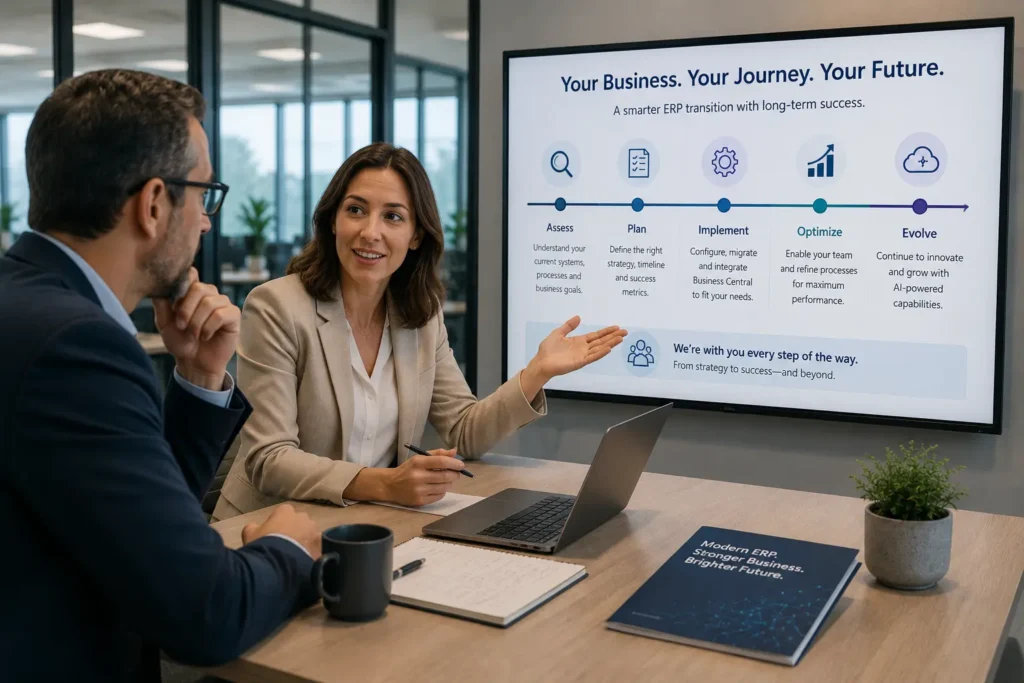
The same way your business once moved beyond QuickBooks to Dynamics NAV or GP, today’s growth may require another evolution.
At Smetric, we help businesses evaluate that transition with clarity—not pressure.
As a Microsoft-focused Business Central consulting firm serving organizations across Los Angeles, we work with manufacturers, distributors, wholesalers, retailers, and professional service firms to determine whether Business Central is the right fit for their next stage of growth.
Sometimes the answer is “not yet.”
Sometimes it’s “now.”
The important part is making that decision based on your business goals—not just the age of your software.
Because upgrading your ERP isn’t about replacing what worked yesterday.
It’s about preparing your business for everything that’s coming tomorrow.
If you’re still unsure whether your organization is ready, read our guide on when to upgrade from Dynamics NAV or GP to Business Central before planning your next steps.
💡 Smetric Insight #4 (Conclusion)
Smetric Insight
Some businesses are ready for Business Central today. Others may still get several productive years from NAV or GP. The important part isn’t rushing into a migration—it’s understanding where your business is headed over the next five to ten years and whether your ERP is positioned to support that journey.
Microsoft’s primary innovation has shifted from Dynamics NAV to Microsoft Dynamics 365 Business Central. Dynamics NAV 2018 was the final NAV release, with Business Central becoming its direct successor. Organizations still using NAV can continue operating, but many are evaluating Business Central to benefit from cloud capabilities, continuous updates, and Microsoft’s ongoing investment in AI and modern business applications.
Yes. Microsoft has announced that product support, regulatory updates, and technical support for Dynamics GP are scheduled to end on December 31, 2029, with security updates continuing until April 30, 2031. While many businesses continue to run GP successfully, now is a good time to evaluate long-term ERP strategies and modernization plans.
Yes. Microsoft Dynamics 365 Business Central is the direct successor to Dynamics NAV. It builds on the capabilities of NAV while introducing cloud deployment, automatic updates, AI-powered features, deeper Microsoft 365 integration, and a modern user experience designed for today’s businesses.
Common signs include increasing reliance on spreadsheets, expensive customizations, difficult upgrades, limited remote accessibility, growing interest in AI and automation, and operational complexity that exceeds what your current ERP comfortably supports. If your ERP is slowing business growth instead of enabling it, it may be time to evaluate Business Central.
Migration timelines vary depending on the size of your organization, data quality, customizations, integrations, and business processes. While smaller implementations may be completed in a few months, larger and more complex migrations typically require additional planning. An ERP assessment is the best way to determine the scope and timeline for your organization.
Many organizations are moving to Business Central to take advantage of cloud accessibility, continuous Microsoft updates, built-in AI capabilities, improved reporting, stronger security, and seamless integration with Microsoft 365, Power BI, Teams, and the Power Platform. For many growing businesses, Business Central provides the flexibility needed to support future growth and digital transformation.